Position recap
You’ll be the reason our robots come back. Power, control, and the links that hold them together are yours, from first schematic to the board that ships, tested in real water, not just on the bench.
- Location
- Bari Metropolitan Area, Italy
- Department
- Engineering, R&D
- Employment Type
- Full time, 36h/week
- Location Type
- Hybrid, starting mostly on-site
- Compensation
- Starting between €40,000 and €50,000 TC (Total Compensation), depending on seniority, and up from there. Salary plus contributions, comparable across countries, not just Italy.
We’re happy to evaluate senior candidates too, adjusting the offer accordingly, if the move is a real step up and a fast-moving environment is where you want to be. - Level
- C1 to B1 for entry to mid-level seniority, up to B3 for more senior roles, under the Italian Metalworking Industry National Collective Bargaining Agreement (CCNL Industria Metalmeccanica).
We’re hiring more than one Electronics Engineer right now.
About the role
A5 S.r.l. builds marine surface and underwater robotics for ocean biodiversity monitoring. We design whole systems vertically, building our own prototypes in-house and testing them on our own sea sites. Engineering and lab work run out of A5’s marine robotics laboratory in Puglia.
This role sits in the marine robotics engineering team, responsible for the on-board systems that power and control A5’s autonomous underwater and surface robots: imaging and sensing systems, control boards, power distribution, thruster controllers, and the communication links that hold everything together. Every hour a robot spends operating without a cable back to shore depends on electronics that don’t fail under extreme environments.
We build our own PCBs in-house, so we’re looking for an engineer who wants to own a board from first concept schematic through prototypes, testing, and pre-series.
Iterative engineering through trial and error is part of our process: a part that fails at sea teaches you more than a simulation ever could. Shortening that loop includes working with new tools, AI included, as part of how you design and validate. The best work here happens in long, uninterrupted stretches of real focus, not chopped up between meetings.
Who we’re looking for
Someone who’s built and debugged real electronics, not just simulated it. You’re just as comfortable with a schematic as with a soldering iron, and you don’t need a fully-specced plan before you start moving.
You think fast, take ownership without waiting to be asked, and show up with ideas instead of waiting for a spec. As the team grows, there’s a real path to leading it.
We’re a small, early-stage company, so you’ll end up doing more than the job title suggests. That has to sound like a feature to you, not a bug.
We’re looking for team people, not solo contributors. A PhD skips the line, but it’s not required: we think people grow into this role, so a lighter background is a fine place to start.
Key Responsibilities
You’ll report to our CTO, working closely with the Mechanical, Optics, and Industrial Design teams on every decision and integration that shapes the final robot.
Embedded Electronics Design
- Design and iterate on the enabling electronics of imaging and sensing systems, control boards, power distribution, thruster controllers, communication, and wiring for underwater and surface robots, working within the constraints of space, thermal, power budget, and signal interference.
- Select components rated for continuous marine operation, balancing reliability against cost and availability.
Firmware & Systems Integration
- Write and debug firmware for embedded systems, and integrate sensors, actuators, and communication modules onto the robot’s electrical architecture.
- Make sure power and data lines coexist cleanly with the mechanical and optical systems sharing the same sealed hull.
Prototyping & Manufacturing
- Design custom PCBs for external manufacturers.
- Fast-prototype electronics in-house using tools such as manual or automatic pick-and-place (PnP) machines, a reflow oven, and a paste dispenser.
Testing & Field Validation
- Test and characterize boards and wiring harnesses on the instrumental bench first, then in an in-house robot pool, and eventually at sea.
- Track failure modes across deployment cycles and use that data to inform the next revision.
Cross-Functional Collaboration
- Work with the Mechanical, Optics, and Industrial Design teams to make sure electronics are well integrated with the other robot subsystems, optimizing for structural, sensing, and actuating characteristics.
- Keep internal technical documentation and wiring diagrams: clear, updated, structured, and something a teammate can actually rely on later.
Outreach
- Represent the company at scientific and industry events, trade and career fairs included, when it’s actually needed.
Qualifications
You don’t need to check every box above. We look at each candidate’s own areas of experience and weigh them on their merits.
Required
- A degree in electronics engineering, electrical engineering, experimental physics, or a similarly quantitative field.
- Experience with schematic capture and PCB design tools (KiCad, Altium, or equivalent).
- Working knowledge of embedded firmware development in C or C++.
- Familiarity with embedded sensing and opto-electronics such as imaging, LEDs, and field sensors.
- Familiarity with communication protocols used in embedded systems (I2C, SPI, CAN, or similar).
- Familiarity with power electronics fundamentals: power regulators, batteries, power budgeting.
- Experience with ESCs, ideally for BLDC motors or thrusters, and actuator controllers.
- Comfortable moving between design work and hands-on bench testing.
- Open to using AI tools as part of the design process, and to trying new R&D methods rather than sticking to the way things have always been done.
Preferred
- Experience with marine, aerospace, avionics, or other harsh-environment electronics is a plus.
- Hands-on experience with sea trials or field testing of electronic prototypes is a plus. We test in real water, regularly, so this isn’t the team for anyone who dissolves on contact with water.
- Basic knowledge of mechanical or optical integration, enough to design around enclosures and sensors rather than after the fact, is a plus.
Language
- English comes first, in documentation, reports, and presentations alike: we want everything accessible across all our offices in the EU. Italian is fine too, mostly for casual chat with colleagues, just not required.
Curious what it’s actually like to work here, our values, and how the hiring process runs? See Culture & Hiring Process.
Read it ↗This isn’t a standard HR interview. We go straight to the point, and honesty counts for a lot. There’ll be calm days and rough ones, just like the sea. That’s part of the adventure.
Applications go straight to our team. Send us your CV and your best opening line. We read every one personally, and we will write back to everyone by hand.
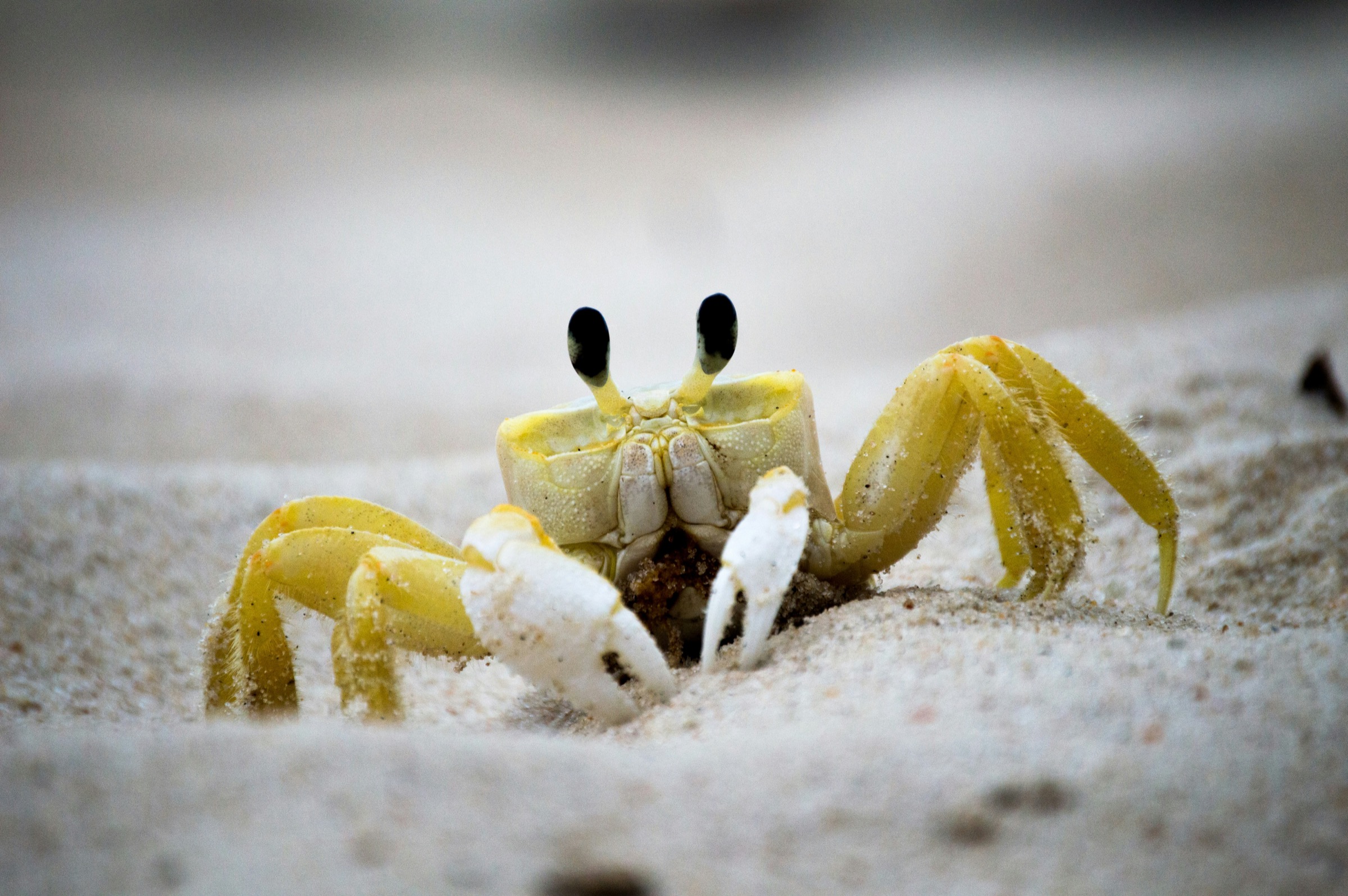
hr@a5revolve.co ↗Okay, you’ve reached the end of the page, but maybe the beginning of something else. Since you’re curious enough to have read this far: why the crab? It’s fast, resilient, sharp enough to check every grain of sand before it trusts it, and strong enough to hold its ground on a beach that never sits still. That’s you?
The instruments on the left just read 1,000 m. You’ve reached the bottom, literally.